Okay, first of all, isn't that just a really cool name? I remember when I was a kid, we used to have these quiet writing sessions in 3rd grade. I would spend a portion of my time writing fantasy stories (that usually made little sense) and the other half making up names for the characters in these stories. For some reason, I just really really liked a name that could roll off my tongue. But that's besides the point. Basically, I picked this book up, once again, based on the cover art.
Oh silly me, I've forgotten to say the title. It's called The Amulet of Samarkand and is part of the Bartimaeus trilogy. The plot revolves around this boy called named Nathaniel and the spirit he summoned, known as Bartimaeus. The books are all set in London, though in different time periods. Now, as I have mentioned before, historical fiction and fantasy are both favorite genres of mine, so you can imagine how much I loved this book when the author decided to combine them both. Basically, there is a world of magicians that call on spirits from their own world in order to do the magician's bidding. Nathaniel is young and inexperienced and he summons a old and powerful djinni, Bartimaeus, to take revenge on a person who wronged him in the past. The plot is very complicated and has several twists near the end, so it would take a while for me to explain. However, the main problem that arises in this book is that Bartimaeus figures out his master's birth name--a fatal mistake throughout the entire world of magicians. Nathaniel has to figure out a way to solve this problem of he's totally screwed.
The book starts out with a scene about halfway through the intended story and then works its way backwards to tell the full story. I'm sure you've read books like that before. Sometimes, it works out nicely and sometimes it leaves you utterly confused as to what's happening. In the case of The Amulet of Samarkand, it would be the former. It flows well and the breaks made to change to the past all make perfect sense.
Another interesting aspect about how the author, Johnathon Stroud writes is the way he switches from point of view nearly every chapter. Again, this style works for some books but not for others. However, I think it really added a nice effect for these books because climactic scenes from multiple perspectives added a lot of interesting angles that you would not have noticed otherwise. When the book is told from Nathaniel's perspective, the author switches to third-person narration but changes to first-person when it's from Bartimaeus. Also, when it's told from Bartimaeus's perspective, he always adds interesting little footnotes with either personal quips or remarks or bits of historical information added with a slight fantastical twist. Trust me, you'll understand what I mean if you read it.
Anyway, long story short: good book, definite recommendation if you have interest in fantasy novels and historical fiction. There are a few parts that are a bit of a drag to read, but there's no shortage of action scenes if that's what your looking for.
Tuesday, March 15, 2011


Thursday, March 10, 2011
The Knife of Never Letting Go
Good evening ladies and gentlemen. I'm sure it has been a torturous two weeks waiting for me to write another blog post. I've decided to grace you with my presence one last time before the quarter ends. Now that you've read the opening paragraph, go ahead and scroll down. Make some comment about how the book sounds interesting, if only you had enough time to read it. Get that comment grade up to an A! Chances are you've only got a couple days before the quarter ends.
Now that those comment fiends are gone, let's get on with the book review. I've read a couple books since last week, including City of Thieves, The Little Book, and Prey. But today we're going to talk about Patrick Ness's The Knife of Never Letting Go, the first in a trilogy.
The Knife of Never Letting Go starts out from the perspective of a boy named Todd. It's written as if it's his diary, and he's not very literate. If you've ever read books like Wuthering Heights where the dialogue is written as it sounds, you know how annoying it is to read broken English. His broken English isn't even consistent. Sometimes you can barely understand what Todd is trying to get across, and other times he sounds like a normal narrator.
Don't let the somewhat annoying narration stop you from reading The Knife of Never Letting Go, though. It's an extremely unique and interesting book. The book is set on an unnamed planet, a couple years after the first wave of settlers arrived. Todd lives in a small village inhabited by only men. He's told that all the women in the town died from a disease. Everyone (or at least Todd thinks it's everyone) on the planet who didn't die from the disease can hear each other's thoughts. As you can imagine, this causes lots of mayhem and confusion. Todd's parents are killed, and he ends up running away. In the wilderness, he finds a girl named Viola. He finds out that Viola and her parents' were scouting out the planet for the second wave of colonists when their pod crashes, killing both of her parents. Men from Todd's town have started to follow him, so the two of them run away together.
I won't give anything more away to avoid spoilers, but I highly recommend this book. If you like a good love story that isn't narrated by a girl (stupid girly emotions), this book is perfect. At times it can seem slow, but it's well worth getting through to the end, because there are LOTS of plot twists. LOTS!!!
Now that those comment fiends are gone, let's get on with the book review. I've read a couple books since last week, including City of Thieves, The Little Book, and Prey. But today we're going to talk about Patrick Ness's The Knife of Never Letting Go, the first in a trilogy.
The Knife of Never Letting Go starts out from the perspective of a boy named Todd. It's written as if it's his diary, and he's not very literate. If you've ever read books like Wuthering Heights where the dialogue is written as it sounds, you know how annoying it is to read broken English. His broken English isn't even consistent. Sometimes you can barely understand what Todd is trying to get across, and other times he sounds like a normal narrator.
Don't let the somewhat annoying narration stop you from reading The Knife of Never Letting Go, though. It's an extremely unique and interesting book. The book is set on an unnamed planet, a couple years after the first wave of settlers arrived. Todd lives in a small village inhabited by only men. He's told that all the women in the town died from a disease. Everyone (or at least Todd thinks it's everyone) on the planet who didn't die from the disease can hear each other's thoughts. As you can imagine, this causes lots of mayhem and confusion. Todd's parents are killed, and he ends up running away. In the wilderness, he finds a girl named Viola. He finds out that Viola and her parents' were scouting out the planet for the second wave of colonists when their pod crashes, killing both of her parents. Men from Todd's town have started to follow him, so the two of them run away together.
I won't give anything more away to avoid spoilers, but I highly recommend this book. If you like a good love story that isn't narrated by a girl (stupid girly emotions), this book is perfect. At times it can seem slow, but it's well worth getting through to the end, because there are LOTS of plot twists. LOTS!!!
Thursday, March 3, 2011
I am the Messenger
So, after about 3 blog posts of stalling, I have finally gotten around to posting about I am the Messenger. I think there's actually a pretty good reason as to why it took me so long. Generally, if I really like a book, I'll finish it within a matter of days, regardless of length. This book has taken about 4 or 5 weeks. Not a very good sign. To be fair though, school has just been awful lately and I've been staying up late and getting an average of 6 hours of sleep a night so I haven't had very much time. Still, I am usually fairly generous in my critiques of book but this book has managed to gather a larger amount of complaints than normal.
The premise of I am the Messenger is about this guy named Ed Kennedy who is just a very mediocre guy. He's not very good at anything but not totally awful at everything either (except sex. He mentions that he's terrible at sex)--he's just a regular Joe. He works as a cabdriver in a relatively small town, has three close friends, one of which he is hopelessly in love with, and a very smelly old dog named the Doorman. Early on in the book, he tells the readers that cards play an important role in his life--he would often have his friends over to play cards and he would soon discover how important cards would become.
The premise of I am the Messenger is about this guy named Ed Kennedy who is just a very mediocre guy. He's not very good at anything but not totally awful at everything either (except sex. He mentions that he's terrible at sex)--he's just a regular Joe. He works as a cabdriver in a relatively small town, has three close friends, one of which he is hopelessly in love with, and a very smelly old dog named the Doorman. Early on in the book, he tells the readers that cards play an important role in his life--he would often have his friends over to play cards and he would soon discover how important cards would become.
One day, he discovers a single playing card in his mailbox, the Ace of Diamonds. On it were three streets. Thus begins Ed's story as he goes to these various locations in order to help people. Each case contains a different person and each person has a different problem. As you might imagine, he receives the other three Aces, each slightly different in terms of clues and Ed continues to go around his town and help people.
The plot itself is really not bad at all. I like how it works out and the process is very suspenseful at times. However, the bad part is the author's writing style. Zusak is a good writer and his style worked beautifully for The Book Thief but for some reason, it just didn't click with me in this book. The short brief sentences that made his descriptions so powerful and emphatic just didn't seem to work as well for I am the Messenger. Keep in mind, this is just my opinion--many of my friends say that they loved this book and thought the writing worked fine but I just simply didn't enjoy it as much.
Also, there were several points in the plot in which I thought to myself, "How the hell is that even possible?? Nobody would ever react like that! Come on!". Perhaps the author realized this and only added it to add to the dramatization of the scene but I generally have a problem with unbelievability when it comes to realistic fiction.
That being said, I don't think that this is a bad book and isn't necessarily a waste of time to read. It has an interesting ending and certainly a very engaging plot line. I'd classify it under the category of "good time passer" but not exactly a "must read before you die". It's up to you. Good luck.
Thursday, February 17, 2011
The Road
It's not often that I come across a book that I can't say anything negative about. There's usually something in a book that I find repetitive, annoying, or just plain boring. Cormac McCarthy's The Road, though, is in a completely different spectrum. In my previous blog posts I've tried to inject some humor into my writing, but doing that here wouldn't be appropriate. The Road is simply the best book I've ever read.
The Road starts out extremely drearily. It's set in a post-apocalyptic world. Nearly everything is dead. The few remaining humans have devolved to cannibalism. The Road follows a father and son who, after realizing they can't survive another winter so far north, are travelling south. It's eventually revealed that the mother committed suicide right after giving birth to the son, a while before the beginning of the book.
I didn't expect to like The Road when I first started reading it. It isn't action packed. It's simply beautiful and moving.
My favorite part of The Road is how little background information McCarthy gives you. The reader is given no details about the cataclysmic event that caused the world to become so lifeless.. The father and son's names are not given. This all leads to a sense of cloudiness and confusion, which fits very well with the post-apocalyptic theme.
There isn't much more you can say about The Road. It's simply an amazing book. I don't want to give anymore plot details, lest I give anything away. I realize this post is extremely short compared to the others, but that's merely because there is so little rant about with The Road. Go out and read it right now. Trust me, it will change your life.
Wednesday, February 9, 2011
Well, I lied.
Okay, sorry guys. I know that all of you are desperately awaiting my review of I am the Messenger, but I'm afraid that's going to be put on hold for another week or so because I've just been so busy. Yes, I know you're all disappointed but please try to contain it.
Still, I think you all would enjoy this next book. I certainly did. The title is Good Omens by Neil Gaiman and Terry Pratchett, both excellent authors by the way. If I had to choose a couple adjective to describe this book (like in that SSO homework stuff), I would choose awesome, hilarious, and clever. Plus, it's super cool. I mean, just look at this cover title. Tell me you wouldn't be attracted by this. Yes, yes you would. Also, the beginning letters of each chapter are really big and intricately designed. I love it when they do that.
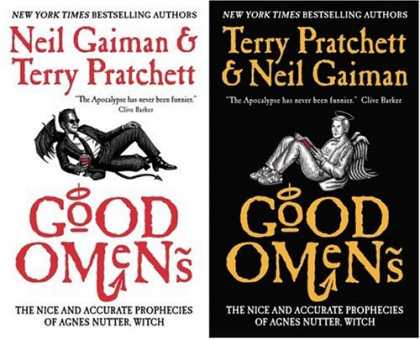
Anyway, if you've ever read anything by either one of these authors, you'd have a pretty good sense of what the book is going to be like. Most people I ask who have read Good Omens say that they prefer Neil Gaiman but I personally like Terry Pratchett better. He's definitely got an off beat sense of humor which you probably won't grasp the first time around until you go back and read it again. You will often be struck by this realization that a particular inane comment regarding some character's name was actually a clever reference and completely hysterical.
Silly me, I haven't explained the premise of the book. The protagonists of this book are a fallen angel named Crowley, an angel named Aziraphale, a witch named Anathema, and a witch hunter named Newt. Oh, and the Antichrist. There is also a quote on the front of the book by Clive Barker (author of Abarat--also a good book) saying, "The Apocalypse has never been funnier." That is quite a good description seeing as this book is describing the Apocalypse and how it plays out.
Already, this sounds like a promising book, doesn't it? Well, trust me, it's well worth the time. It starts out with Crowley (supposedly the serpent that told Eve to eat the apple) delivering the Antichrist to a hospital. However, this hospital, staffed by Satanic nurses, misunderstood Crowley's overly subtle hints, and they ended up switching the Antichrist with another ordinary Muggle. I mean, human. That human child was raised by Satanic and Angelic guides with both sides hoping to "convert" him to their side. Satanic forces sent a nanny who told the child this lovely nursery rhyme:
"This little piggy went to Hades
This little piggy stayed home
This little piggy ate raw and steaming human flesh
This little piggy violated virgins
And this little piggy clambered over a heap of dead bodies to get to the top."
Somewhat different from the more common version, no? Still, isn't there something inherently wrong about pigs eating roast beef? I don't know. Maybe it's just me. Anyway, this is the beginning of the supernatural beings' side of the story.
The other half is focused around a man named Newt and a witch named Anathema. Anathema's great-great-great-great-great grandmother, Agnes Nutter (also a witch), wrote a book known as The Nice and Accurate Prophecies of Agnes Nutter, Witch. This is also a key point in this book seeing as these prophecies were often cryptic, extremely confusing, supremely vague, but always correct. Newt signs up to be a witch hunter in the hopes of finding a simple, paying job, and lo and behold, he actually finds a witch. Anyway, whenever I start to summarize, I tend to just ramble on and on, so I'm going to stop myself and let you figure out what happens for yourself.
All right, so you've got a general idea of what's going on and, in case I haven't made it clear, I am highly recommending this book. There's a possibility that you won't understand all the subtleties the first time but trust me, it will be worth it to go back and read it again. It's an awesome book. Also, something that could add to the confusion would be the fact that if a character has an accent or a certain way of speaking, the authors wrote it the way it was pronounced. For those of you who read Wuthering Heights (Oh my God, that book was awful. Bored the pants off of me. I mean, it probably wouldn't have been too bad if I wasn't forced to read it within two days so that I could finish my paper, but still), think of Joseph and his Yorkshire accent, tone it down about four notches, and you'd have a pretty good idea of what you can expect from certain characters in Good Omens. However, don't freak out--it honestly isn't that bad.
All right, that's it for now. Enjoy Good Omens!
Thursday, February 3, 2011
Orson Scott Card
When it comes to Science-Fiction/Fantasy literature, Orson Scott Card has got it all. He's received multiple awards for his writing, including two Hugo awards and two Nebula awards (for the same two books). His Ender's Game series is one of the most popular works of science fiction ever written. Instead of simply paraphrasing more of Card's Wikipedia page, I've decided to provide my diligent readers with a link.
If you haven't already read Ender's Game (the first one), then you need to click that link up there again. Seriously. Ender's Game is one of my favorite books ever. I've only met one person who didn't LOVE Ender's Game, but I can't remember who it was, so obviously that person's opinion is wrong. The twenty other novels/short stories (yep, twenty) that follow Ender's Game can get a little bit repetitive, but for those of you who love the series a lot (maybe too much?), they are definitely worth it.
That brings us to what I dislike about Orson Scott Card's writing. It's very, very repetitive. For those of you taking U.S. history, I would compare Card to the 19th century writer Horatio Alger, who basically wrote the same story over and over with different character names. Maybe Card isn't that bad, but he sure comes close. In all the books I've read by him (I've read four of his series, with twelve books in total), he fails to successfully create more than one type of main character. All of his main characters are exactly like Ender; unbelievably intelligent, difficult to relate to, and immensely dedicated to whatever goal they have. Even though Ender, Bean (from a series branching out from Ender's Game), Rigg (from Card's novel Pathfinder), and Bartholomew Coleman (from Card's Empire series) are all extremely cool characters, they are nothing like normal people. They seem to always know exactly what to do and when to do it. Card's characters also have an unbelievably ridiculous sense of duty. After killing all of his friends during their failed assassination attempt, Coleman (from the Empire series) has the following conversation with an unnamed agent,
"I wish we could pretend these guys were a bunch of foreign assassins," said Cole glumly.
"I know," said the agent. "You knew them, right?"
"They were my team," said Cole. "But they got distracted from the mission."
"What mission?"
"Preserve and protect the Constitution of the United States," said Cole. "No matter what you think of the President, assassinating him does not preserve of protect anything."
Pretty ridiculous, huh? After two whole books of getting to know and love Coleman's team, Card makes Coleman kill his entire team to, "Preserve and protect the Constitution of the United States". You know what the worst part is? The President they were trying to assassinate was actually a manipulative asshole; he needed to die! This annoying theme of duty and responsibility is repeated throughout Card's other novels, including Ender's overly repetitive sense of guilt towards his accidental xenocide (the genocide of an entire alien species).
Here is where I sum up my blog post. If you wanted, you could read a boring paraphrase of everything I've just written. Or, you could just listen to some peaceful music that I feel sums up my blog post very well.
If you haven't already read Ender's Game (the first one), then you need to click that link up there again. Seriously. Ender's Game is one of my favorite books ever. I've only met one person who didn't LOVE Ender's Game, but I can't remember who it was, so obviously that person's opinion is wrong. The twenty other novels/short stories (yep, twenty) that follow Ender's Game can get a little bit repetitive, but for those of you who love the series a lot (maybe too much?), they are definitely worth it.
That brings us to what I dislike about Orson Scott Card's writing. It's very, very repetitive. For those of you taking U.S. history, I would compare Card to the 19th century writer Horatio Alger, who basically wrote the same story over and over with different character names. Maybe Card isn't that bad, but he sure comes close. In all the books I've read by him (I've read four of his series, with twelve books in total), he fails to successfully create more than one type of main character. All of his main characters are exactly like Ender; unbelievably intelligent, difficult to relate to, and immensely dedicated to whatever goal they have. Even though Ender, Bean (from a series branching out from Ender's Game), Rigg (from Card's novel Pathfinder), and Bartholomew Coleman (from Card's Empire series) are all extremely cool characters, they are nothing like normal people. They seem to always know exactly what to do and when to do it. Card's characters also have an unbelievably ridiculous sense of duty. After killing all of his friends during their failed assassination attempt, Coleman (from the Empire series) has the following conversation with an unnamed agent,
"I wish we could pretend these guys were a bunch of foreign assassins," said Cole glumly.
"I know," said the agent. "You knew them, right?"
"They were my team," said Cole. "But they got distracted from the mission."
"What mission?"
"Preserve and protect the Constitution of the United States," said Cole. "No matter what you think of the President, assassinating him does not preserve of protect anything."
Pretty ridiculous, huh? After two whole books of getting to know and love Coleman's team, Card makes Coleman kill his entire team to, "Preserve and protect the Constitution of the United States". You know what the worst part is? The President they were trying to assassinate was actually a manipulative asshole; he needed to die! This annoying theme of duty and responsibility is repeated throughout Card's other novels, including Ender's overly repetitive sense of guilt towards his accidental xenocide (the genocide of an entire alien species).
Here is where I sum up my blog post. If you wanted, you could read a boring paraphrase of everything I've just written. Or, you could just listen to some peaceful music that I feel sums up my blog post very well.
Friday, January 21, 2011
500 Pounds of Tiger and the Pacific Ocean
If you have read The Life of Pi by Yann Martel, then the title of my post will likely have made sense to you. If not, then I shall further enlighten you. The Life of Pi is about a young Indian boy named Piscine (Pi, for short) who's father owns a zoo. The book is divided in three parts with the first part explaining his background and upbringing, part two being the majority of the plot content, and part three as a closing section. But first, I shall divulge my own background concerning this book.
I have always been an avid reader although it's a little more difficult now because of the wonderful homework load that my fantastic school dishes out, but I still find time to squeeze in a book or two. I read The Life of Pi a while back and it has remained one of my favorite books for a long time. I received this book as a birthday present when I was in 6th grade and my friend had told me that he had searched for a long time through Pages for All Ages (remember that place? Loved it. Would spend entire mornings in there...) for a book that I had not read. I had heard about that book before and, as shallow as this may sound, I used to (and still sort of do) judge a book by the cover. The cover art for the version of The Life of Pi I received was really pretty cool. I'd attach a picture, but I have neither the time nor the patience to figure out how to download the correct drivers to connect my ancient scanner with my newer computer. Sorry.
EDIT: Oh look, I figured out how to do hyperlinks. Thanks Christina! Click here to see a picture of my cover art.
The only negative comments I have about this book were largely a matter of opinion. At the time I had read it, I was largely into action and fantasy (although my repertoire has since broadened) and so the semi-sluggish pace of the plot was a little dull. Then again, it probably didn't help that I was reading this during a long, 6-hour car trip. Still, I have gone back and read it several times (a sure sign that I like the book) and it seems to get better every time.
I have always been an avid reader although it's a little more difficult now because of the wonderful homework load that my fantastic school dishes out, but I still find time to squeeze in a book or two. I read The Life of Pi a while back and it has remained one of my favorite books for a long time. I received this book as a birthday present when I was in 6th grade and my friend had told me that he had searched for a long time through Pages for All Ages (remember that place? Loved it. Would spend entire mornings in there...) for a book that I had not read. I had heard about that book before and, as shallow as this may sound, I used to (and still sort of do) judge a book by the cover. The cover art for the version of The Life of Pi I received was really pretty cool. I'd attach a picture, but I have neither the time nor the patience to figure out how to download the correct drivers to connect my ancient scanner with my newer computer. Sorry.
EDIT: Oh look, I figured out how to do hyperlinks. Thanks Christina! Click here to see a picture of my cover art.

Anyway, the book starts out describing Pi's multiple religions and then we move on to the plot point that the book is centered about. Pi is stranded in the middle of the Pacific Ocean with a 500 pound, fully grown, male Bengal tiger. The rest of the story is about his amazing journey and his desire to live. He experiences many incredible encounters--all of which border on the impossible but have just enough believability to make it seem credible. As I said before, the more possible a book seems to me, the more I enjoy it. (I love fantasy too--this is just about realistic fiction)
I especially enjoyed Martel's active descriptions as the book progressed. If I were to compare it to Zusak (author of The Book Thief), I would say that Zusak was much more surreal, leaving your mind to conjure up most of the images with well placed phrases whereas Martel would give very solid descriptions, similar to a movie. However, it will be up to you to read both and decide which one you prefer.
The only negative comments I have about this book were largely a matter of opinion. At the time I had read it, I was largely into action and fantasy (although my repertoire has since broadened) and so the semi-sluggish pace of the plot was a little dull. Then again, it probably didn't help that I was reading this during a long, 6-hour car trip. Still, I have gone back and read it several times (a sure sign that I like the book) and it seems to get better every time.
So, overall, I would definitely recommend this book to anyone who's not afraid to plow through a somewhat dry beginning. I promise that it gets much more interesting later on though.
I'll be reviewing I am the Messenger by Markus Zusak soon, as soon as I finish actually reading it. I probably would have finished it in time, if it weren't for a library mishap. Turns out, my card expires exactly one day before my renewal date meaning I had to return the book otherwise I'd get fined 20 cents. I don't have 20 cents. Oh well. I hope you enjoy Life of Pi!
Subscribe to:
Posts (Atom)